
Last updated October 16, 2026
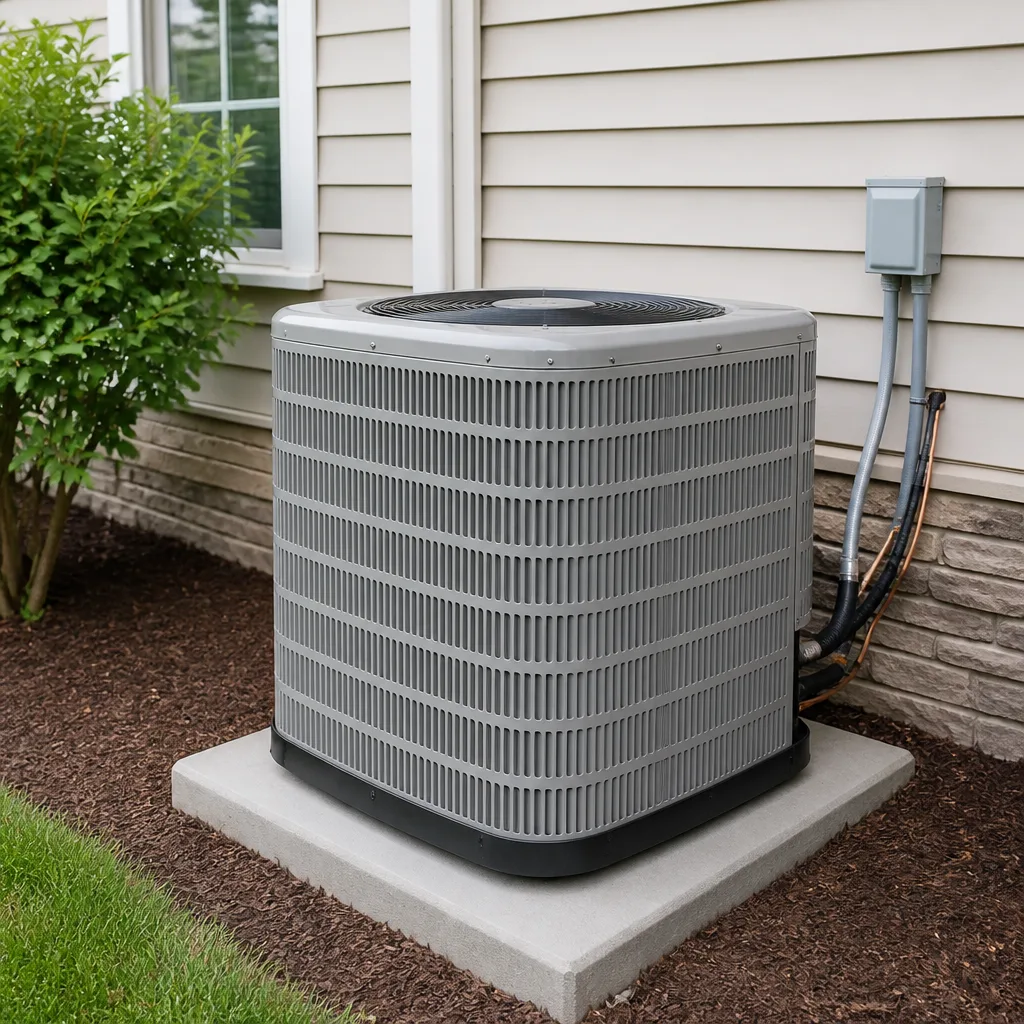 AC repair
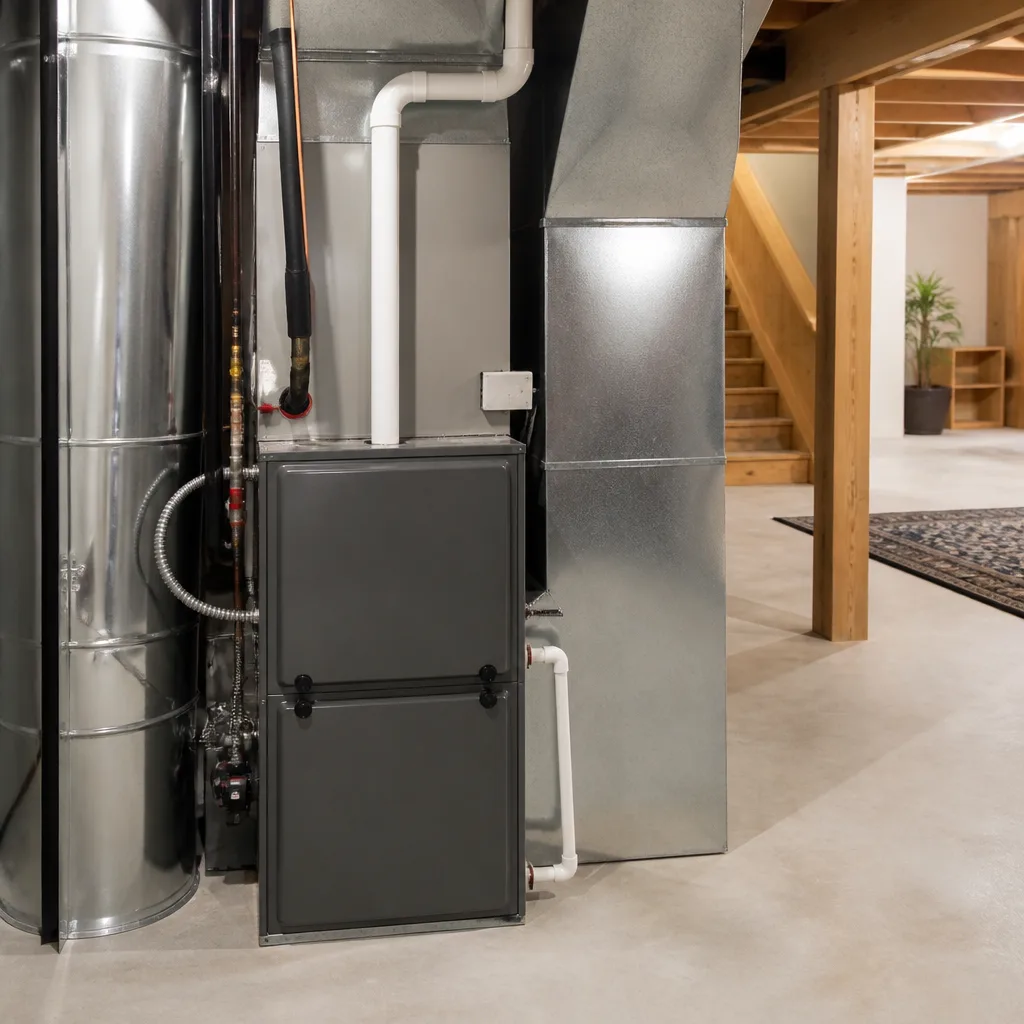 Furnace & heating
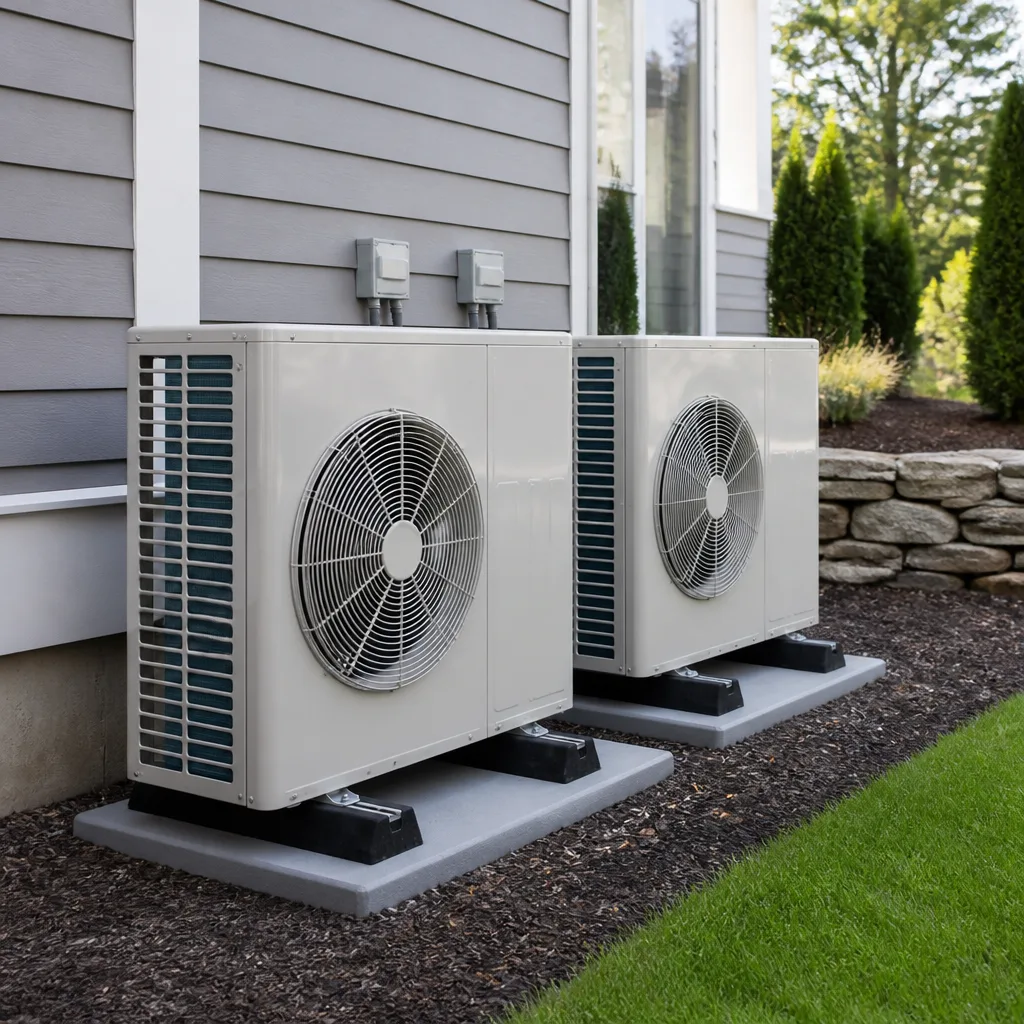 Heat pumps
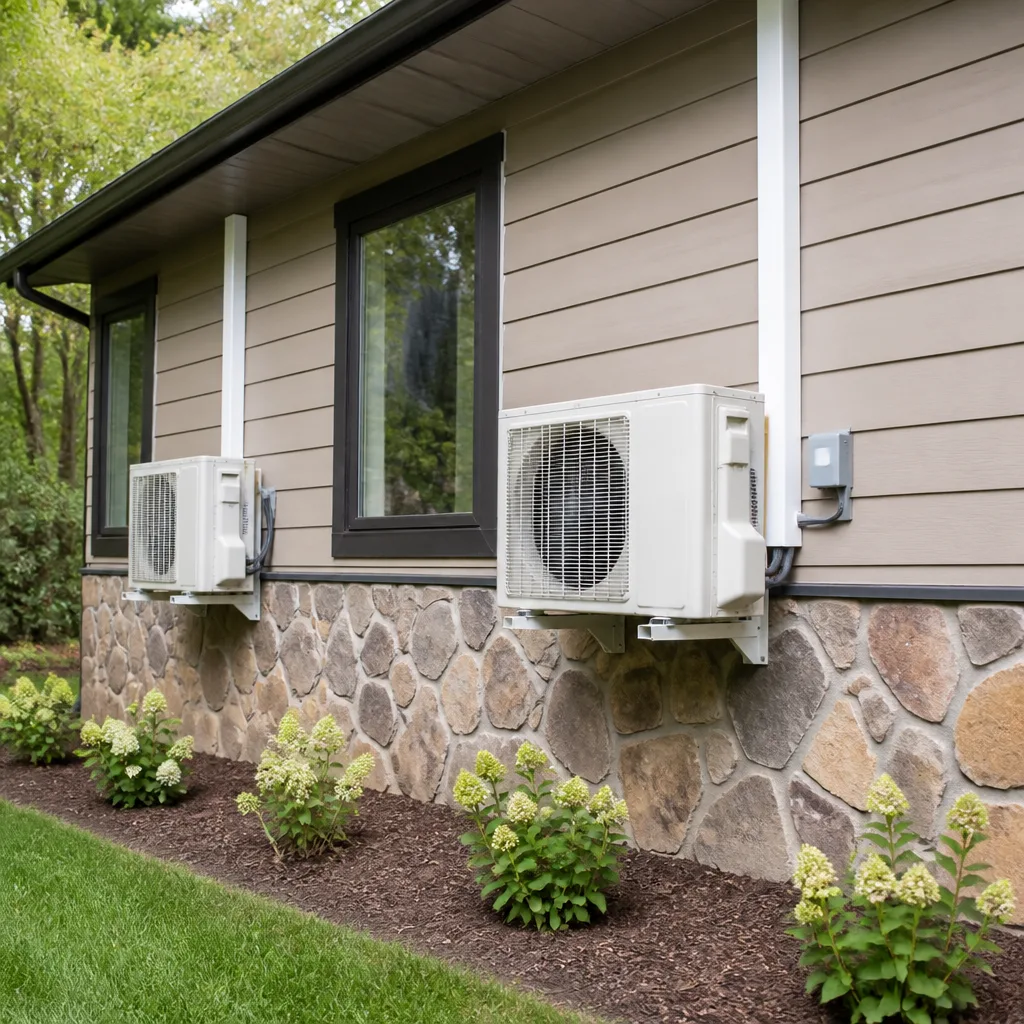 Ductless mini splits
 Carrier
 Trane
Trane Goodman
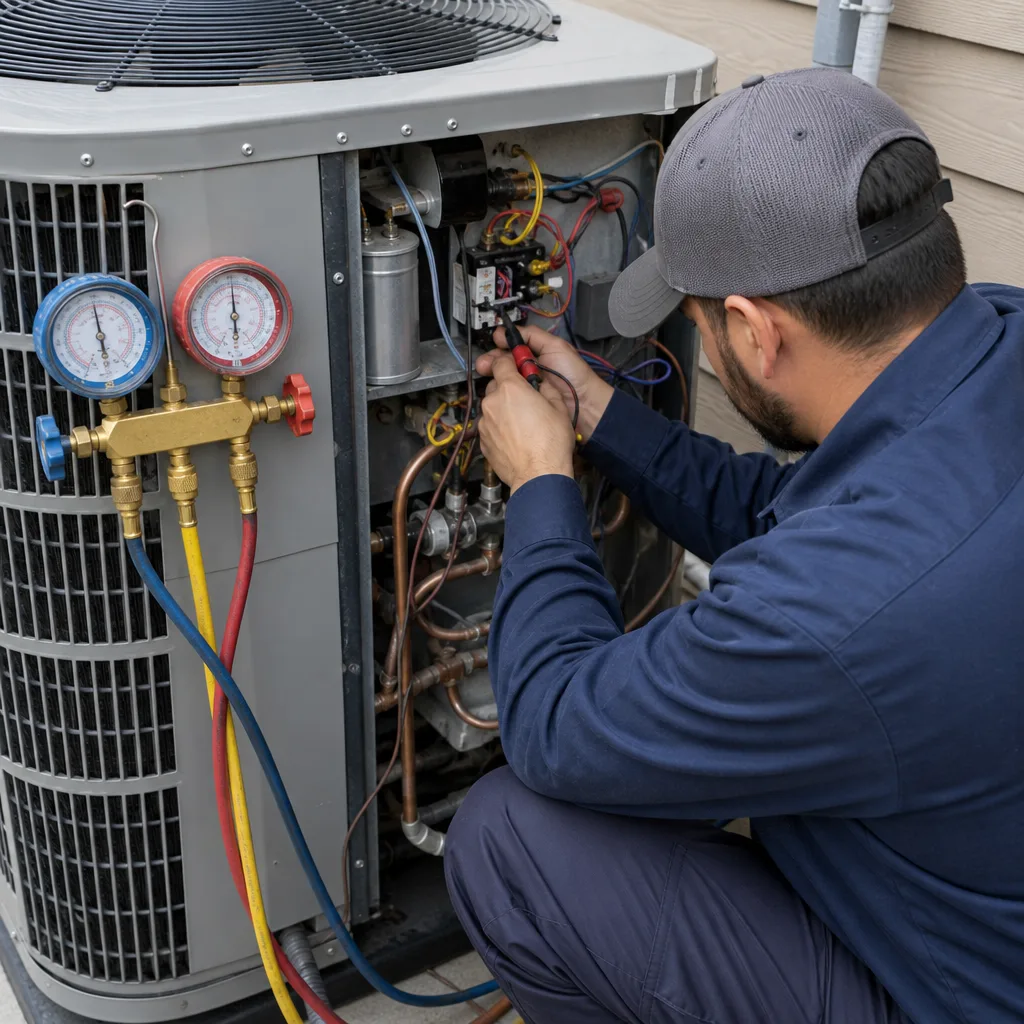
Seasonal tune-up and full diagnostic on your Carrier, Trane, or Goodman system - readings shown to you before any repair is proposed
Diagnosis first, numbers second - you approve the repair price before a single part goes in.
Get your free estimateThe Complete Guide to HVAC in Houston
Houston averages 106 more cooling degree days per year than Phoenix. That number surprises people who think of Texas heat as a dry, desert problem. It isn’t. Houston’s challenge is a specific pairing of Gulf moisture, a cooling season that runs from March through October, and a building stock that ranges from 1920s pier-and-beam bungalows to post-Harvey rebuilds on raised slabs. This guide and our more guides & resources explain what that combination means for the equipment you buy, the repairs you authorize, and the money you spend. If you own a home in Houston, the decisions in these pages will shape your comfort for the next decade.
Quick Answer
HVAC in Houston is a humidity-management problem first and a temperature problem second. A system sized for Dallas or Phoenix will underperform here because it won’t remove enough moisture from the air, leaving you cold and clammy at 72°F. The right Houston system pairs a properly sized AC or heat pump with sealed ductwork, a correctly set blower speed, and a maintenance schedule built around our 8-month cooling season.
Styles & brands we work with
Table of Contents
- Why Humidity Is the Real Problem in Houston
- SEER2 Ratings: What Actually Pays Off in Houston
- Houston Building Stock: Why Your House Dictates the System
- Heat Pumps in Houston: What Works, What Doesn’t
- Permits and Inspections: Houston’s ZIP Code Problem
- Maintenance That Actually Matters in This Climate
- What HVAC Work Costs in Houston
Why Humidity Is the Real Problem in Houston
Most national HVAC guides treat cooling as a simple equation: remove enough heat to hit a target temperature. In Houston, that equation leaves out the variable that decides whether your living room feels comfortable or swampy. The technical term is latent heat load, which is the energy required to remove moisture from the air. Sensible cooling lowers the temperature. Latent cooling removes the water vapor. Both matter. In a Gulf Coast climate, latent load often exceeds the sensible load during spring and fall, when the temperature is mild but the air is saturated.
A system with a cooling capacity that looks correct on paper can still leave a Houston home at 72°F with 65% relative humidity. That feels sticky, smells musty, and encourages mold growth in ductwork and drywall. The thermostat says one thing. Your skin says another. The fix is not always a bigger unit. Often it’s a smaller unit running longer cycles, paired with a whole-home dehumidifier or a variable-speed blower that lets the system run at lower airflow to pull more moisture out before the thermostat satisfies.
We’ve seen this in neighborhoods across Houston: a homeowner replaces a 3-ton unit with a 4-ton unit because the house “never gets cool,” only to find the new system short-cycles and the humidity problem gets worse. Oversized equipment cools the air quickly, satisfies the thermostat, and shuts off before it has time to remove moisture. In Houston’s shoulder seasons, when temperatures hover in the 70s and 80s, a short-cycling oversized system is a mold factory waiting to happen.
The practical takeaway: when you evaluate an HVAC proposal in Houston, ask about latent capacity, not just total capacity. Ask how the system will dehumidify during April and October, when the AC runs less but the humidity remains high. A contractor who can’t answer that question in plain English is not thinking about Houston’s actual climate. Our How to Hire a HVAC Contractor in Houston: A Step-by-Step Guide can help you vet the right professional.
SEER2 Ratings: What Actually Pays Off in Houston
SEER2 is the efficiency rating system that replaced SEER in 2023. It measures seasonal cooling efficiency under more realistic test conditions. Manufacturers advertise SEER2 numbers up to 28 or higher. In Houston, the question is not what’s available, but what makes financial sense given our electricity rates, our cooling hours, and the way we actually use our systems.
Here’s the honest math. Houston homes run their air conditioners for roughly 2,000 to 2,500 hours per year. That’s three times the national average. At that runtime, efficiency differences compound fast. A 14.3 SEER2 system (the current federal minimum) versus an 18 SEER2 system can differ by $300 to $500 per year in electricity costs for a typical 2,000-square-foot Houston home. Over a 15-year system life, that’s real money.
But the relationship is not linear. The jump from 14.3 SEER2 to 16 SEER2 saves more per dollar spent than the jump from 18 SEER2 to 22 SEER2. Above about 18 SEER2, you’re paying for features like variable-speed compressors and premium control boards that improve comfort more than they lower bills. For most Houston homeowners, the sweet spot is a single-stage or two-stage 16 to 18 SEER2 system, paired with a properly designed duct system and an airtight home envelope.
One exception: homes in Houston’s older neighborhoods, like the Heights or Montrose, where the building envelope leaks and ductwork runs through unconditioned attics that hit 140°F in July. In those homes, high-efficiency equipment without duct sealing and insulation upgrades is wasted money. The equipment efficiency rating assumes a baseline of system performance. If 20% of your cooled air is leaking into the attic, your 20 SEER2 system performs like a 15 SEER2 system in practice.
Houston Building Stock: Why Your House Dictates the System
Houston is not one housing market. It’s a patchwork of construction eras, each with its own HVAC quirks. Understanding which era your house belongs to tells you more about the right system than any national guide ever will.
Pier-and-beam bungalows (1920s – 1950s) – These homes in the Heights, Garden Oaks, and East End have raised foundations with crawlspaces. Supply ducts often run through the crawlspace, which in Houston’s climate means hot, humid air blowing against the outside of the ductwork. Insulation on those ducts degrades, falls off, or gets chewed by rodents. The result is warm air at the register and condensation dripping under the house. These homes also tend to have undersized return ducts, because they were originally built for window units or no cooling at all.
1970s slab ranches – Neighborhoods like Sharpstown, Spring Branch, and Pasadena were built fast during the oil boom. Ductwork typically runs through the attic, often flex duct that’s now 40+ years old. Attic temperatures in Houston regularly exceed 130°F in summer. Old flex duct with R-4 insulation loses a significant fraction of its cooling before it reaches the room. These houses also tend to have single returns, which creates pressure imbalances when bedroom doors are closed.
Post-Harvey rebuilds and newer construction (2017 – present) – Homes rebuilt after Hurricane Harvey often have stricter elevation requirements and newer insulation, but the rebuild process was uneven. Some homeowners got properly sealed and insulated ductwork. Others had contractors cut corners under time pressure. We see a surprising number of post-2017 homes with mismatched indoor and outdoor units, improperly charged refrigerant lines, or duct systems that were never balanced after installation.
The practical takeaway: your home’s construction era should drive the conversation with any HVAC contractor. A pier-and-beam bungalow needs a duct assessment before any equipment decision. A 1970s slab ranch needs a return-air analysis. A post-Harvey rebuild needs a commissioning check to verify the system actually performs as designed. Cold Harbour Heating and Air Houston has worked in all of these housing types since 2003, and we’ve learned that the house tells you what it needs if you know how to read it.
Heat Pumps in Houston: What Works, What Doesn’t
Heat pumps have become the default recommendation in many parts of the country. In Houston, they’re viable for most homes, but the conversation requires more nuance than national guides provide. Houston occasionally hits 28°F, as it did during the February 2021 freeze. A standard air-source heat pump still works at 28°F, but its heating capacity drops as outdoor temperatures fall. At 28°F, a heat pump sized for Houston’s cooling load (which is the dominant load) may produce only 60 to 70 percent of the heat the home needs during a cold snap.
That’s where dual-fuel systems earn their keep. A dual-fuel setup pairs a heat pump with a gas furnace. The heat pump handles cooling and moderate heating. When the temperature drops below a set threshold (often around 35 to 40°F in Houston), the system automatically switches to the gas furnace. This gives you the efficiency of a heat pump during our mild winters and the reliability of gas heat when a polar front pushes through.
For Houston homeowners without gas service, a cold-climate heat pump with a variable-speed compressor is the right answer. These units maintain their heating capacity down to much lower temperatures than standard heat pumps, and they modulate output to match the load. They cost more upfront. In Houston’s climate, where heating accounts for maybe 20 to 25 percent of annual HVAC energy use, the payback on that premium is longer than it would be in Minnesota. But it’s still often the best option for all-electric homes.
The real mistake we see in Houston is a contractor who sizes a heat pump based on the cooling load alone and doesn’t discuss what happens at 28°F. Or worse, a contractor who installs a heat pump without confirming the home has adequate electrical service for backup heat strips. When the heat pump can’t keep up, the strips kick on, and a 10kW strip heater running through a cold snap can double your winter electric bill in a week.
Permits and Inspections: Houston’s ZIP Code Problem
Permitting for HVAC work in Houston depends on where your house sits. The City of Houston requires a mechanical permit for new installations, replacements, and most repair work that involves refrigerant lines or electrical connections. The permit is pulled by the licensed contractor, and the work is inspected after completion. If you live in Houston city limits, this is generally straightforward.
The complication comes in the unincorporated parts of Harris County and the dozens of smaller municipalities scattered around Houston. Pasadena, Baytown, Bellaire, West University Place, Humble, and Tomball all have their own permitting requirements. Some are stricter than the city. Some are looser. Some require a separate electrical permit for thermostat or disconnect work that Houston bundles into the mechanical permit. If you live in an unincorporated area of Harris County, the rules can change based on which Municipal Utility District (MUD) serves your neighborhood.
Here’s the practical checklist for homeowners:
- Confirm your jurisdiction. Check whether you’re in Houston city limits, an incorporated suburb, or unincorporated Harris County. This determines which code applies.
- Ask the contractor who pulls the permit. A reputable Houston contractor should answer without hesitation. If they suggest skipping the permit to save money, walk away.
- Verify inspections are scheduled. Most jurisdictions require a post-installation inspection. A contractor who doesn’t schedule it is leaving you with unverified work.
- Check for code compliance on the following items: condensate drain termination, emergency shut-off switch location, disconnect box placement, and clearance from gas meters for furnace venting.
- Get the permit number. The permit should be filed with the jurisdiction and verifiable online in most Houston-area municipalities.
Houston’s humid climate makes code compliance more important than in dry climates. The condensate drain is a prime example. Houston codes require specific drain sizing and termination because an air conditioner in this climate can produce 10 to 20 gallons of condensate per day. A drain that terminates in the wrong place becomes a water damage claim waiting to happen.
Maintenance That Actually Matters in This Climate
National HVAC guides recommend annual maintenance. In Houston, annual maintenance is the bare minimum. Our systems run three times as many hours as the national average, which means components accumulate wear and tear three times faster. The maintenance schedule that makes sense in Minnesota will not keep a Houston system alive.
Here’s the maintenance schedule we recommend for Houston homeowners:
- Spring tune-up (March – April): This is the critical one. Before the cooling season starts, the condenser coil needs cleaning, the evaporator coil needs inspection, the refrigerant charge needs verification, and the blower motor needs testing. A dirty condenser coil alone can reduce system efficiency by 15 to 20 percent.
- Condensate drain flush: This happens during the spring tune-up and should be repeated mid-summer if you haven’t installed a float switch or secondary drain pan alarm. Houston’s humidity means algae grows fast in those drain lines.
- Filter changes (monthly during summer): Houston’s air contains pollen, dust, and construction debris. A 1-inch filter should be checked monthly during peak season. A 4-inch media filter can go 3 to 6 months, depending on household conditions.
- Fall heating check (November): Before the first cold front, the furnace burners or heat strips need testing. You want to find out there’s a problem on a 70°F November day, not on the day Houston drops to 28°F.
- Duct inspection (every 3 – 5 years): Attic ductwork in Houston degrades fast due to heat and humidity. A duct inspection with a pressure test can reveal leaks that are silently costing you 20 to 30 percent of your cooling bill.
The single most important maintenance item for Houston homes is the condensate drain. Clogged drains are the number one cause of water damage claims related to HVAC in our area. A $15 float switch installed on the secondary drain pan can alert your system to shut off before water overflows into your ceiling.
What HVAC Work Costs in Houston
Pricing transparency matters. Here are the realistic ranges we see for common HVAC work in Houston as of 2025. These are total costs, parts and labor included, for a typical single-family home:
- Capacitor replacement: $150 – $300. The capacitor is the component that gives the compressor and fan motors the jolt they need to start. It’s the most common failure in Houston because the heat degrades these parts faster.
- Condensate drain clearing: $100 – $250. Simple when caught early, expensive when water has backed up into the system or the home.
- Refrigerant recharge: $200 – $600, depending on the refrigerant type and how much was lost. Note: a system that needs refrigerant has a leak. A recharge alone is not a fix if the leak isn’t addressed.
- Blower motor replacement: $400 – $900 for a standard PSC motor, $800 – $1,500 for a variable-speed ECM motor. Houston’s long runtimes mean blower motors fail more often here than anywhere else in the country.
- Condenser coil replacement: $900 – $2,200. Coastal air in Houston carries salt and pollutants that accelerate coil corrosion, especially in communities near Galveston Bay or the ship channel.
- Full system replacement (AC + furnace): $7,500 – $14,000 for a 3-ton to 5-ton system with a 14.3 to 18 SEER2 rating, depending on brand, features, and ductwork condition. Every job at Cold Harbour Heating and Air Houston includes a written price before any work begins.
We recommend the AC installation in Houston route when your existing system is more than 12 years old, has a major component failure like a compressor burnout, or uses R-22 refrigerant, which has been phased out and is expensive to recharge. For systems under 10 years old with a straightforward component failure, AC repair in Houston is usually the better financial choice. And if you’re dealing with a specific failure like a cracked heat exchanger or a failed inducer motor, furnace repair in Houston addresses the heating side. If you’re new to all of this, start with the Cold Harbour Heating and Air Houston home page to see how we work.
Common Mistakes to Avoid
- Oversizing the system. Houston contractors have been oversizing AC units for decades. A bigger unit short-cycles, fails to dehumidify properly, and wears out faster from constant start-stop cycling. Ask to see the load calculation.
- Ignoring the ductwork. Replacing a 20-year-old system without inspecting the ducts is like rebuilding an engine and reusing the old oil filter. In Houston’s attics, 20 percent or more of your cooled air can be leaking out.
- Skipping the permit to save a few hundred dollars. Unpermitted work becomes your problem when you sell the house, file an insurance claim, or have a mechanical failure that causes property damage.
- Choosing equipment based on national advertising. The SEER2 rating on the box assumes ideal conditions. Houston’s humidity, long runtimes, and high attic temperatures mean real-world performance varies significantly. Look for a contractor who will show you the numbers for your specific house.
- Deferring the spring tune-up until June. By the time Houston hits 95°F in June, every HVAC company is booked solid. The best time to find a problem is in March, when you can schedule at your convenience.
- Ignoring the condensate drain until water appears. By the time water is dripping through your ceiling, the damage is done. A simple float switch and a clean drain line prevent this entirely.
- Treating the HVAC system as a one-time purchase. Houston systems need active monitoring and maintenance. A 15-year system life requires roughly $1,500 – $2,500 in maintenance over that period. Skipping it costs more in the long run.
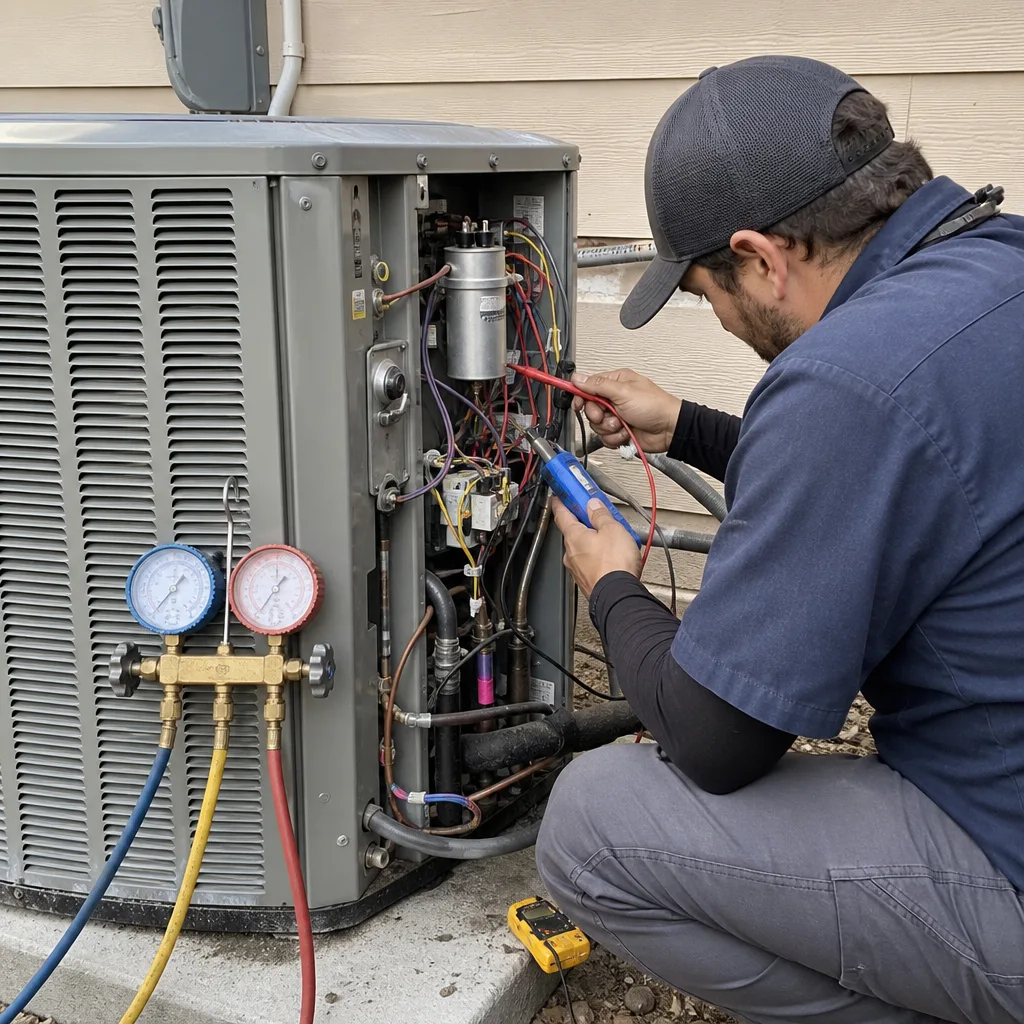
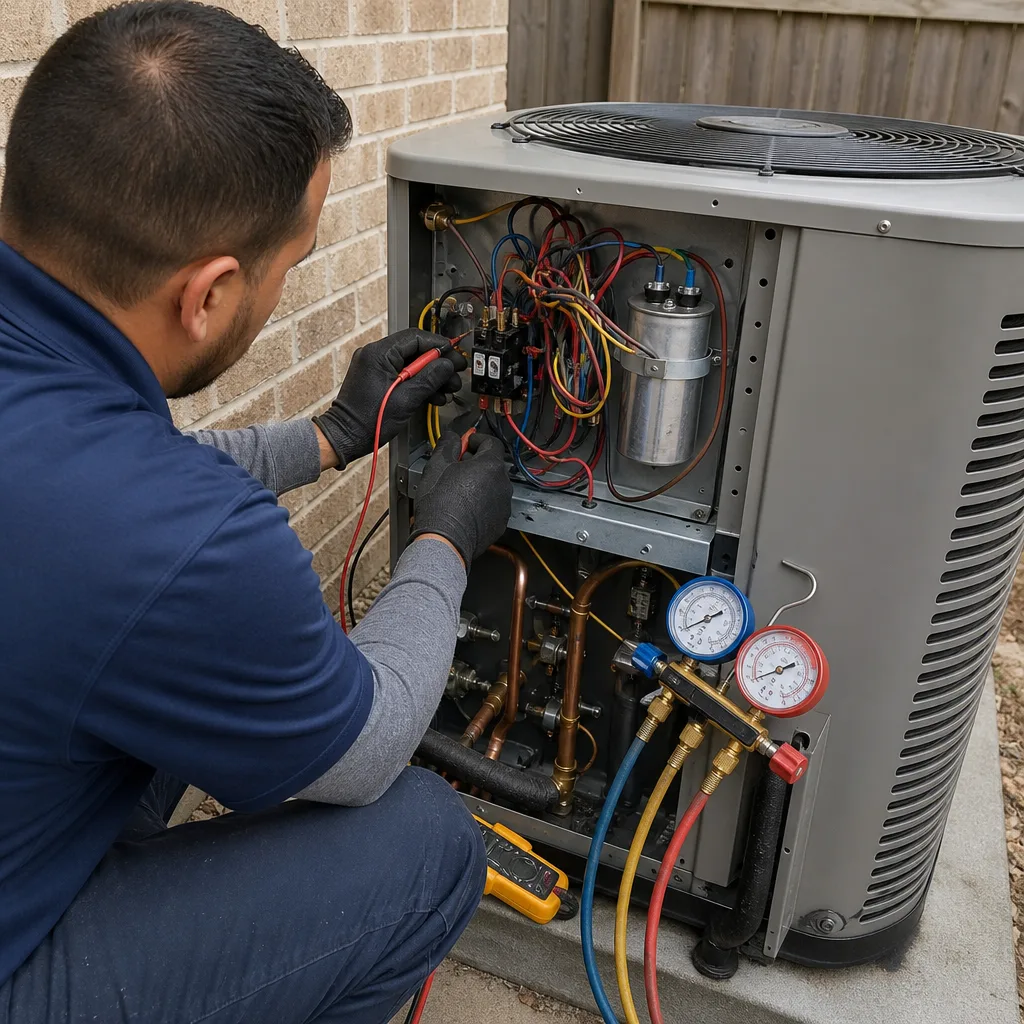
See the difference
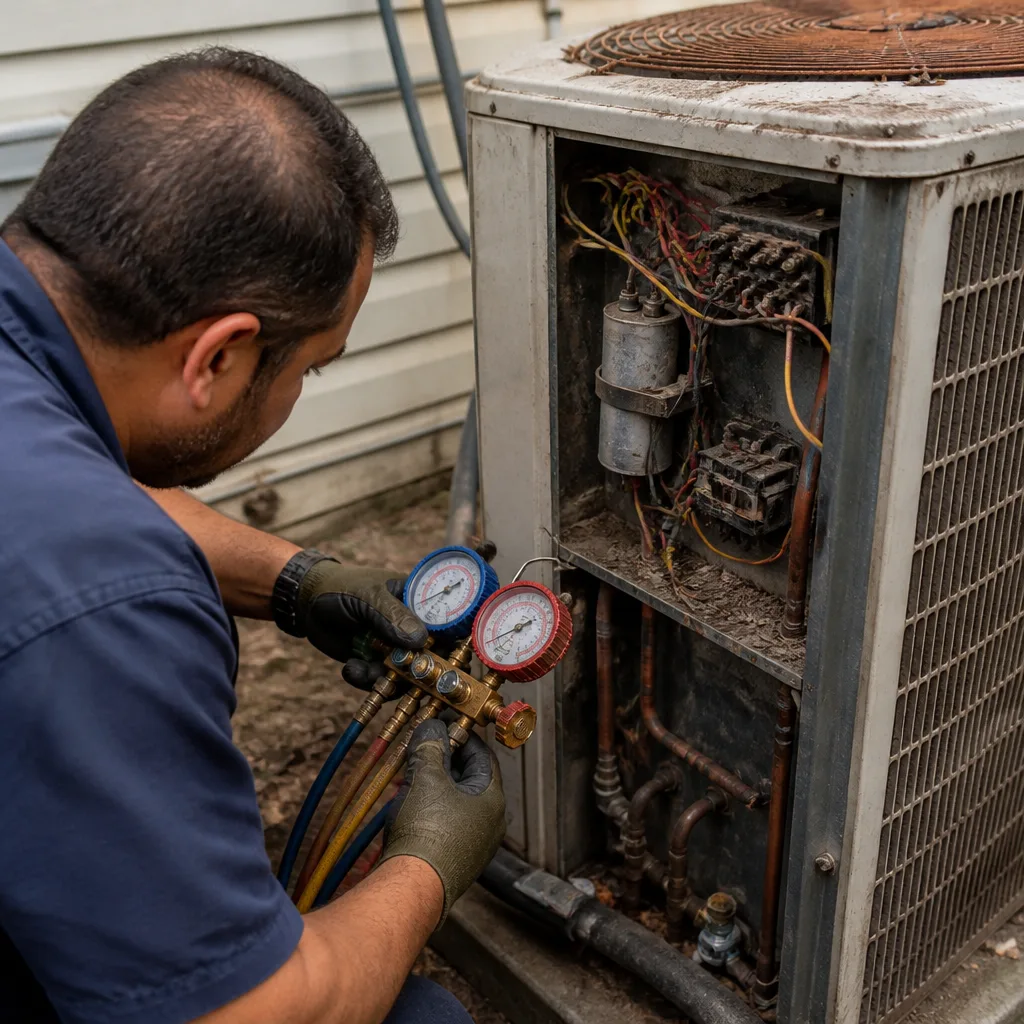 Before
 After
After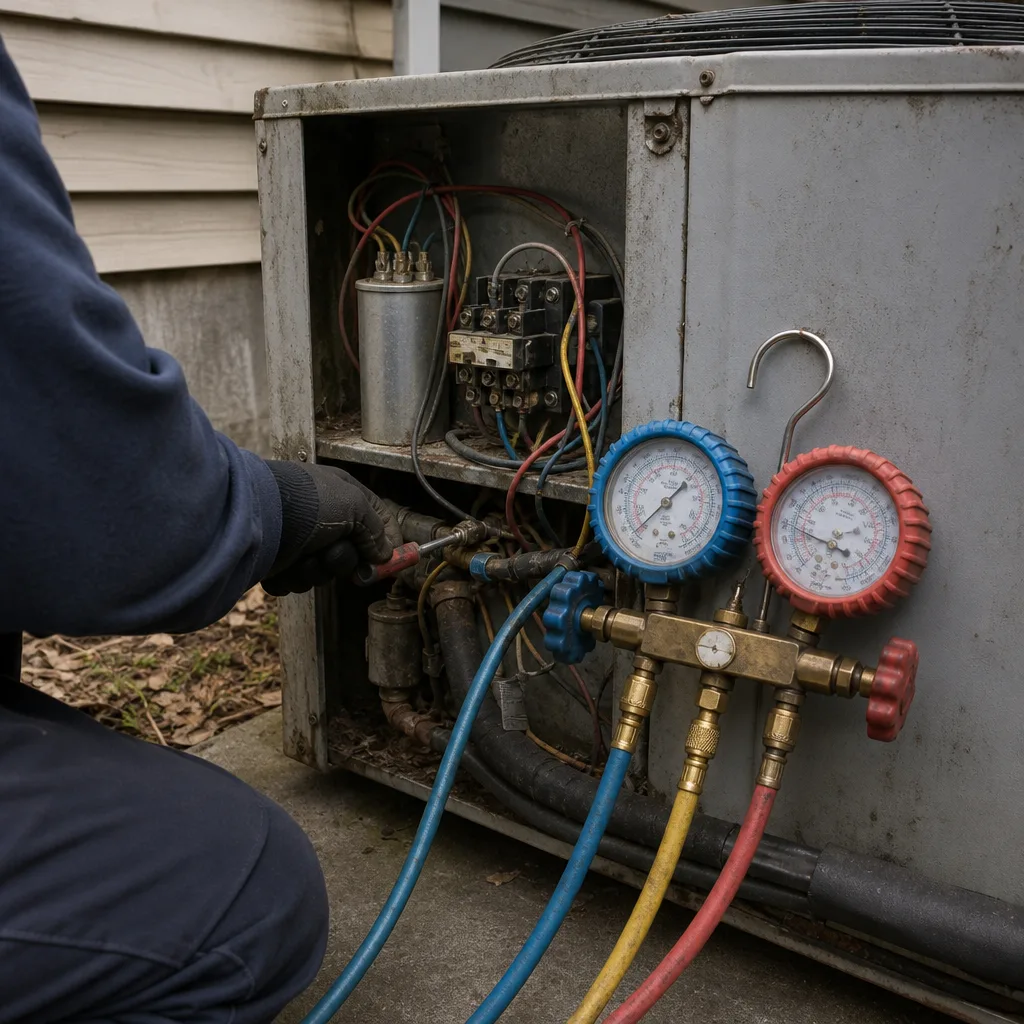 Before
 After
After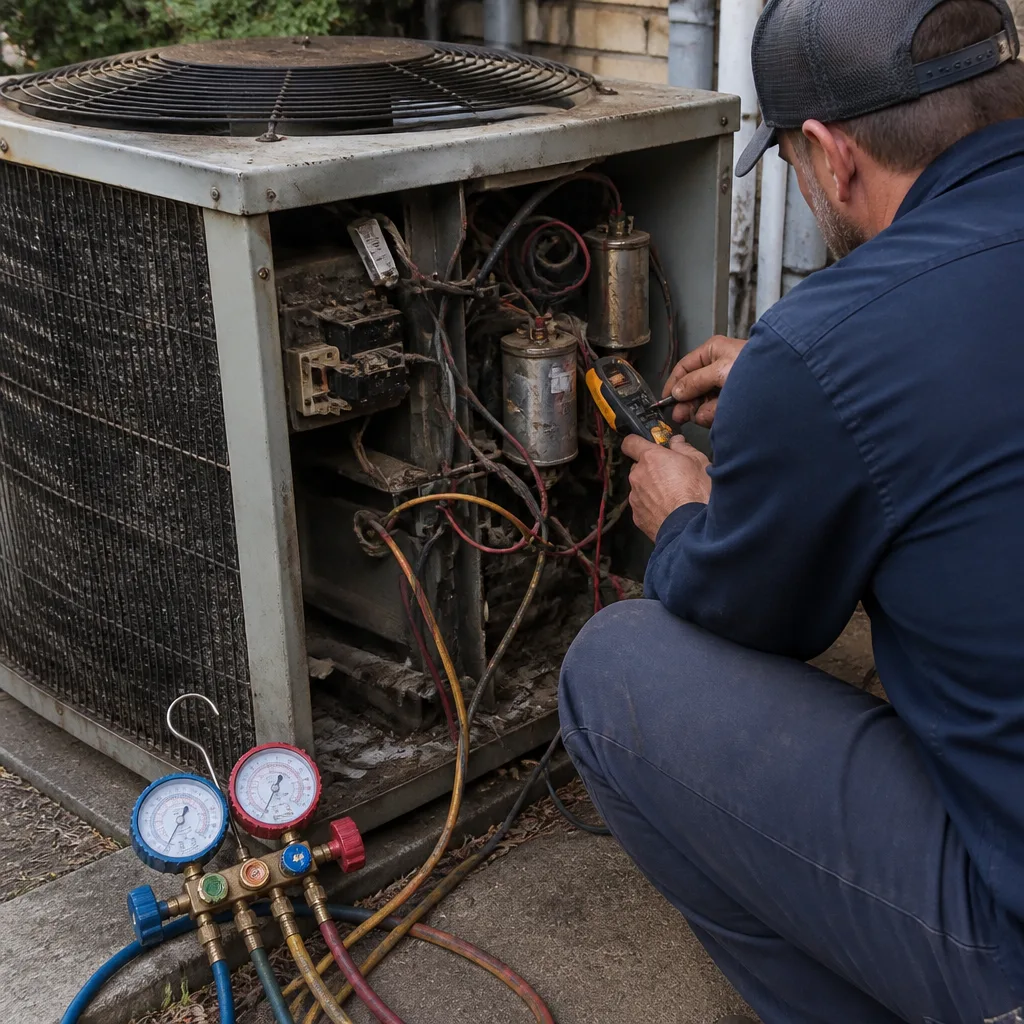 Before
 After
AfterWhen to Call a Professional
Some problems you can see: a frozen coil, water pooling under the indoor unit, or a capacitor that’s visibly bulging. Other problems you can feel: hot air blowing from the registers, weak airflow, or humidity climbing even while the temperature holds. All of these are signals to call someone who does this work every day. Refrigerant handling requires EPA certification. Electrical work on a condenser or air handler involves high voltage. And the high-tension springs inside a furnace draft inducer or the gas valve on your furnace are not things to improvise with. If your system is short-cycling, making new noises, or not holding temperature, the safest call is a trained professional. Cold Harbour Heating and Air Houston offers free estimates in Houston – call (832) 371-9862 and a live person will answer, 24 hours a day, 7 days a week.
Frequently Asked Questions
During peak cooling season (May through September), check a 1-inch filter monthly and replace it when it’s visibly dirty, which typically means every 30 to 45 days. A 4-inch media filter can go 3 to 6 months. Houston’s air is heavy with pollen, dust, and construction debris, and a clogged filter forces your system to work harder while reducing indoor air quality.
Set it to whatever keeps your family comfortable, but understand that every degree below 75°F adds roughly 3 to 5 percent to your cooling bill. More important than the setpoint is the humidity level: a system that keeps your home at 76°F with 45 percent humidity will feel more comfortable than one that holds 72°F with 60 percent humidity. Call (832) 371-9862 if your home feels damp and cool at the same time – that’s a dehumidification problem, not a temperature problem.
A well-maintained system in Houston typically lasts 12 to 15 years, compared to 15 to 20 years in milder climates. Our long cooling season, high humidity, and corrosive coastal air accelerate wear on outdoor units. If your system is past year 12 and facing a major repair, replacement often makes more financial sense than patching it up.
The general rule: if the repair costs less than 30 percent of a replacement and your system is under 10 years old, repair it. If your system is over 12 years old, uses R-22 refrigerant, or has a failed compressor, replacement is usually the better long-term investment. A written estimate will give you the numbers to make the call with confidence.
Yes, in most of the Houston area. The City of Houston requires a mechanical permit for system replacements, and most surrounding municipalities have similar requirements. A reputable contractor pulls the permit and schedules the inspection. Be wary of anyone who suggests skipping the permit to save money.
Yes, and for many Houston homes – especially pier-and-beam bungalows, garage apartments, and room additions – mini-splits are the most practical option. They avoid the duct-leakage problems common in our hot attics and provide zone control. The tradeoff is aesthetic: the indoor wall units are visible, and a whole-house mini-split installation costs more upfront than a traditional ducted system for a similar-sized home. Call (832) 371-9862 and we’ll walk you through the numbers for your specific house.
The Bottom Line
Houston’s climate punishes generic HVAC advice. The humidity demands a system that dehumidifies properly, not just cools. The long cooling season means maintenance is not optional. The building stock varies wildly by neighborhood and era, which means the right system for a Heights bungalow is not the right system for a Katy subdivision house. And the permitting reality changes by ZIP code. The common thread: work with a contractor who puts prices in writing, explains your options in plain English, and stands behind the work. Read our DIY vs Professional HVAC: The Houston Homeowner’s Decision Guide to understand when to call in a pro. That’s how we’ve operated at Cold Harbour Heating and Air Houston since 2003. We price the job before we start, we show up when we say we will, and every repair is backed by our 365-Day Done Right Promise in writing.
Written by Victor Mancini, Owner at Cold Harbour Heating and Air Houston, serving Houston since 2003.